
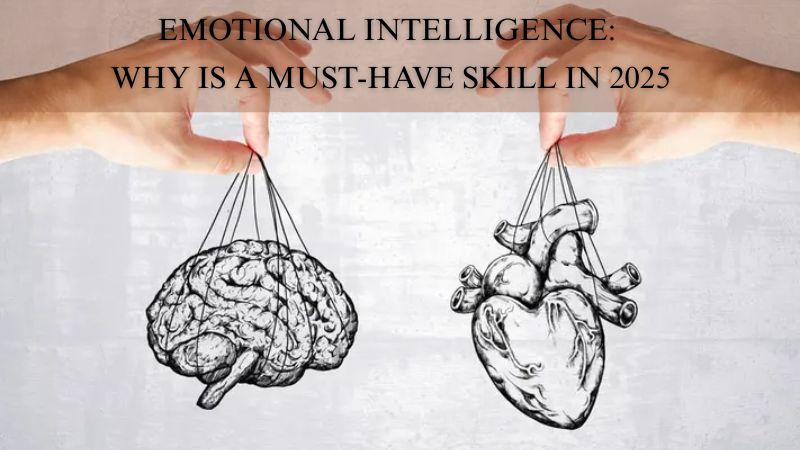
We all feel a range of emotions every day, some positive and empowering while some negative and disempowering. It seems hard to manage emotions in today’s world because there are far too many obstacles in it.
But learning to manage your emotions effectively i.e. emotional intelligence is a must have skill in 2025 life. It may seem a heavy task at first but with some knowledge and a lot of practice, we can learn to manage your emotions and use them at their best.
Important Note: Ability and the courage to accept that you can be wrong, and you need to improve is the first real test of emotional intelligence. So, if you feel that you lack anywhere, remember this is a sign that you are already emotionally intelligent.
Table of Contents
ToggleWhat Is Emotional Intelligence (EI or EQ)?
Key Definition : Emotional Intelligence is the ability of a person to recognize, understand and manage their emotions as well as other people’s emotions. It is the capacity to be aware of, control and express your emotions as well as to navigate interpersonal relationships with both good judgement and empathy.
Why Emotional Intelligence Matters in 2025
The Effects of Low EQ (Emotional Intelligence)
- You get into a lot of arguments.
- You feel others are overly sensitive or over-reactive because the person with low EQ cannot understand how others feel.
- Have frequent Emotional Outbursts.
- Disengage or leave a heated environment.
- Don’t listen to others.
- Blame others.
- Difficulty maintaining friendships and other relationships with others.
Be honest with yourself here, how many signs that you possess here? It is okay if you possess some of these signs, everyone has some of these signs (they just don’t tell anyone).
Dr. Daniel Goleman who coined the term “emotional intelligence” found that CEOs get hired for their business expertise and Intelligence and fired for their lack of ESI, specifically, social awareness.
How to Develop Emotional Intelligence
Sometimes we’re taught to hide or mask the way we feel. The problem with that is when you mask emotions like anger, sadness, frustration, you also dampen and mask love and joy. If you learn to dampen one emotion, you dampen them all. Life can lose its flavour, and we become emotionally flat. The key is to allow yourself to feel the emotion and develop strategies to manage your responses.
Signs You’re Emotionally Intelligent
- Show Empathy.
- Non-judgemental.
- Discuss not argue.
- Accept their mistakes.
- Patiently listen to others.
- Can overcome their emotions.
- Respect everyone’s perspective.
- Understand other people’s emotions.
- Don’t make decisions based on emotions.
- Can understand and communicate their emotions.
The 5 Core Competencies of Emotional Intelligence by Daniel Goleman
Daniel Goleman, who popularized the concept of ’emotional intelligence’, discovered the five competencies of Emotional Intelligence (and social intelligence) by studying high performers:
1. Motivation
It meansusing our deepest preferences to move and guide us towards our goals, to help us take initiative and strive to improve, and to persevere in the face of setbacks and frustrations. Competencies for motivation include achievement drive, commitment, initiative and optimism.
2. Self-Awareness
The more self-aware you are, the more you understand your emotions and reactions. Being in tune with your emotions and reactions allows you to take control and manage your responses. If you can build your self-awareness, each of the other quadrants become easier to master. self-awareness is knowing what we’re feeling in the moment, why we are feeling it and having a reality check of our own abilities. Someone with a greater sense of self-awareness can easily and quicklydescribe their thoughts, wants, and feelings under stress.
Lean into discomfort: The biggest obstacle to increasing your self-awareness is the tendency to avoid the discomfort that comes from seeing yourself as you really are. Growth is uncomfortable. Rather than avoiding a feeling, your goal should be to move toward the emotion, into it and eventually through it.Don’t be afraid of your emotional mistakes.
- Know what pushes your buttons: Recall some moments where you reacted in a way you shouldn’t have.
- What situations prompted those emotions?
- What automatic thoughts went through your mind?
- How strongly do you believe those automatic thoughts?
- What cognitive distortions came into play?
- How could you shift your perspective?
- What might the outcome look like now?
By identifying your own emotions and reactions, you become more mindful and start the process of building control. Note how you typically respond to these situations.
- What are the benefits of your response?
- What are the consequences of your responses?
- What would be the benefits if you changed your responses?
- And what will you do with this knowledge?
Observe the ripple effect from your emotions: You need to understand the effect that your emotions have on other people. The key to observing the ripple effects of your emotions is to watch closely how they impact the other people immediately. Do other people feel more elevated or down when they meet you?
Ask for feedback: One of the easiest tools to increase our own self-awareness is to simply ask for feedback from those around us.
Their advice and thoughts can be proven invaluable. But remember not all feedback is positive. Take the advice and tips that the person offers as tools to help you improve yourself and your style. You can ask, “How did I deal with you at that time? Would you say I was sensitive to your feelings and emotions?”
Here’s some tips for receiving feedback.
- Don’t overreact.
- Ask more questions for clarification.
- Listen carefully and try not to get defensive.
- Don’t take offense and instead, ask, “What can I learn?”
Note: When you receive negative feedback, there are two choices, you can put your feelings aside and try to learn something from the situation, or you can get angry and let emotions get the best of you.
3. Self-Regulation
Self-regulation is your ability to use awareness of your emotions to actively choose what you say and what you do. Self-regulation builds upon self-awareness and allows you to choose how to respond to an emotion actively when you’re aware of it. When you understand your own emotions and can respond the way you choose to them, you have the power to take control of difficult situations.
Strategies for Self-Regulation:
- Talk less and listen more.
- Take Control of your Self talk.
- Stop and think about the situation.
- Train your attention to focus on controllables.
- Learn a valuable lesson from everyone you encounter.
- Focus your attention on your freedoms rather than your limitations.
4. Empathy
Empathy is described as sensing what people are feeling, being able to take their perspective to understand them and build rapport with them. It allows us to have better communication with people around us and increase our understanding of others. Empathy can simply mean to put ourselves in the other person’s shoes to feel their pain. It can enable us to resolve conflicts and improve our relationships with coworkers, clients, and customers.
Showing Empathy: To use empathy effectively, you need to understand that every behaviour has some positive intention behind it. You need to put aside your own viewpoint and see things from the other person’s perspective. Then only you will be able to understand their behaviour. If you show empathy, the other person will feel accepted and open up to you. Then you can suggest some changes to them as well.
Types of Empathy:
It can also show up in several different stages:
Cognitive Empathy: Being aware of the emotional state of another person.
Emotional empathy:Engaging with and sharing those emotions.
Compassionate Empathy:Involves taking action to support other people.
Compassionate empathy is the most active form of empathy. It involves not only having concern for another person and sharing their emotional pain but also taking practical steps to reduce it.
For example, imagine that one of your team members is upset or angry because he or she delivered an important presentation badly.
Acknowledging their hurt is valuable and affirming their reaction by showing signs of those feelings yourself is even more valuable. But best of all is putting aside some time for them and offering practical support or guidance on getting through the situation and preparing for next time. To use empathy effectively, you need to put aside your own viewpoint and see things from the other person’s perspective.
11 Effective Techniques to Develop Empathy
- Listen more.
- Get feedback.
- Walk in others’ shoes.
- Examine your biases.
- Ask better questions.
- Random acts of kindness.
- Explore the heart not just the head.
- Cultivate your sense of curiosity to know the unknown.
- Challenge yourself and do something new, it will make you humble.
Empathy vs Sympathy: Empathy is often confused with sympathy, but they are not the same thing. Sympathy is a feeling of concern for someone and a sense that they could be happier. Unlike empathy, sympathy doesn’t involve shared perspective or emotions. Empathy means to put ourselves in the shoes of other person and feel their pain.
5. Social Skills
The social skills include skills needed to interact with others to form good bonds with them.Most of us would agree that qualities like empathy and compassion are valuable ingredients to healthy relationships. But we often neglect to show those qualities when it mattersmost, like when we fail to show understanding to a close friend or partner when they’re going through a difficult time.
Scientists have studied what psychologist and author Adam Grant (https://adamgrant.net/) calls the perspective gap. In short, this term describes the fact that it’s extremely challenging to put ourselves in another person’s shoes. We often forget how specific situations feel, even if we’ve experienced very similar circumstances. If we’ve never experienced something similar,
- can you imagine how that limits our perspective?
- How do we bridge the gap?
Demonstrating qualities such as empathy and compassion means that we try our best to see a situation through another person’s eyes. But we have to go further than drawing on our own experiences. Showing true empathy means exploring the why.
- Why does this person feel the way they do?
- What are they dealing with that I don’t see?
- Why do I feel differently than they do?
Social skills are described as handling emotions and relationships well, accurately reading social situations and networks. Using these skills to persuade, lead, negotiate, and settle disputes. The competencies associated with social skills are influence, communication, conflict management, change catalyst, building bonds, collaboration, and team capabilities.
Social Awareness: Social awareness is the ability to recognize and, understand the moods of other individuals and entire groups of people. People who manage relationships well can see the benefit of connecting with many different people, even though it’s someone they might not be fond of.
The weaker the connection you have with someone, the harder it is to get your point across. If you want people to listen, you must practice relationship management, seek benefits from every relationship, especially the challenging ones. Working on your emotional and social intelligence can help you build trusting relationships. Trust is one of the essential ingredients for building great relationships, winning teams, and organizational cultures of greatness. Trust builds engaged relationships and engaged relationships create successful leaders, managers, salespeople, and team members.
Strategies for building social skills:
- Observe the ripple effect from your emotions.
- Manage and understand Perceptions.
- Know Yourself and your triggers.
- Be open to change.
- Separate Facts from Emotions.
- Build Rapport.
- Greet people by name.
- Be open and more curious.
- When you care, show it!!
- Make timing everything while interacting with others. Ask about the right things at the right time.
In Summary: Why Emotional Intelligence Truly Matters
You must have understood why emotional intelligence is a must have skill in 2025. Emotional intelligence is directly related to resilience and our ability to engage with challenges, sustained performance, rebound quickly from adversity, and learn and grow from our experiences.
When you’ve developed ESI, you can cope with stressful conditions and maintain a positive outlook and are less likely to burn out.
If you found this helpful, share it with someone who could benefit. Or leave a comment below with your biggest takeaway!
Ready to strengthen your emotional intelligence? Start today.
Frequently Asked Questions
The term first appeared in 1964, gaining popularity in the 1995 bestselling book Emotional Intelligence by psychologist and science journalist Daniel Goleman.
The Aim of Emotional Intelligence is to strengthen a person so that he or she can recognize, manage and handle their emotions effectively.
EQ means Emotional Quotient. It measures the ability of a person to recognize, understand and manage their emotions effectively.
IQ is Intelligence Quotient which measures a person’s reasoning ability and is primarily used in academics. EQ means Emotional Quotient which measures a person’s ability to handle their emotions.
John D. Mayer and Peter Salovey developed the four-branch model of Emotional Intelligence. The four branches are perceiving emotions, using emotions to facilitate thought, understanding emotions, and managing emotions.
Patience is the highest level of emotional intelligence.
Ability and the courage to accept that you can be wrong and you need to improve is the first real test of emotional intelligence.
The four pillars of emotional intelligence are: self-awareness, self-management, social awareness, and relationship management.


3 Responses
The emphasis on self-awareness and the courage to improve really stood out to me. It’s a great reminder that emotional intelligence isn’t about being perfect, but about being open to growth—which feels especially relevant in 2025’s high-pressure environment.
I agree that emotional intelligence is crucial for 2025, especially with all the stress and challenges we’re facing today. It’s also refreshing to see how EQ isn’t just about managing emotions but also building empathy and strong social connections.
This article provides a clear and practical guide to emotional intelligence. The breakdown of the five core competencies is especially helpful for self-improvement.